Introduction
Having guests visit your home should be an enjoyable experience, but things can become stressful when your dog barks continuously, jumps on visitors, runs toward the door, or becomes overly excited. These behaviors are common in dogs, especially those that enjoy meeting people or have not learned how to handle visitors calmly.
The good news is that you can teach your dog to behave more calmly when guests arrive. With patience, consistency, and positive reinforcement, your dog can gradually learn that visitors are a normal part of everyday life.
In my view, the most important thing is to understand why your dog reacts the way it does. Some dogs bark because they are excited, while others feel nervous or protective of their home. The right training approach depends on the reason behind the behavior.
This guide explains practical ways to teach your dog to stay calm when guests visit, reduce unwanted behavior, and create a comfortable environment for everyone.
1. Understand Why Your Dog Gets Excited Around Guests
Before starting training, observe how your dog behaves when someone approaches your home. Understanding the reason behind the reaction can help you choose an appropriate solution.
Some dogs become excited because they enjoy attention. They may bark, jump, wag their tails, and rush toward visitors as soon as the door opens. Other dogs feel uncertain around unfamiliar people and bark to create distance.
A dog that is frightened may hide, growl, freeze, or repeatedly attempt to move away. These behaviors should not automatically be treated as disobedience.
Watch your dog’s body language and consider what happens before the reaction begins. Does your dog become excited when the doorbell rings? Does it react only when unfamiliar people enter? Does it settle after a few minutes, or does the behavior continue throughout the visit?
These observations can help you identify the situations that need the most attention.
If your dog shows intense fear, lunges at visitors, or has a history of biting, keep everyone safe and seek guidance from a qualified behavior professional. Do not force the dog to interact with people it finds frightening.
2. Teach Your Dog to Settle in a Safe Place
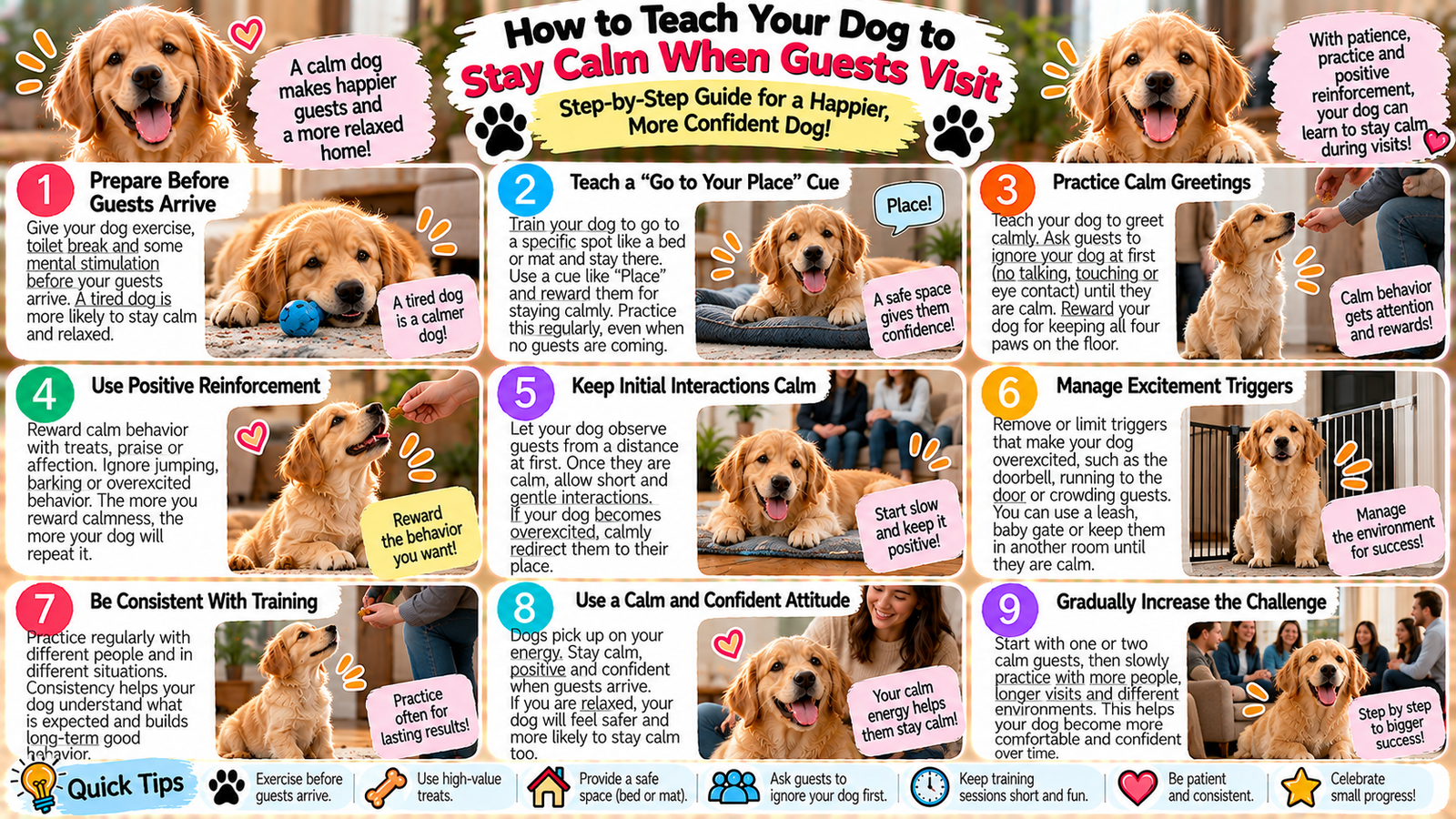
One helpful way to manage guest visits is to teach your dog to relax in a designated area. This could be a comfortable bed, a quiet room, or a secure area separated from the entrance.
Choose a place where your dog feels comfortable and is not constantly disturbed. Provide fresh water and a suitable resting area. Familiar toys may also help, provided your dog uses them safely.
Begin teaching the behavior when no guests are present. Encourage your dog to approach its bed and reward it for standing or sitting there. Gradually reward longer periods of relaxed behavior.
You can introduce a cue such as “go to your bed” once your dog begins understanding the activity.
Practice for a few minutes at a time. When your dog can settle comfortably, introduce mild distractions before eventually practicing while a familiar visitor is present.
A safe space should never be used as punishment. It should give your dog a comfortable option when the household becomes busy.
3. Practice Basic Commands Before Guests Arrive
Teaching a few basic commands can make guest visits easier to manage. Useful skills include sit, stay, come, and go to your bed.
Start in a quiet environment where your dog can focus. Reward each successful response with a small treat, praise, or another reward your dog enjoys.
For example, practice asking your dog to sit before receiving its food bowl or before you attach its leash. These everyday activities help reinforce calm behavior.
Once your dog understands the commands at home, practice them with mild distractions. Ask a family member to walk into the room while you reward your dog for remaining settled.
Do not expect your dog to perform perfectly when several unfamiliar people arrive at once. Busy entrances can be difficult even for dogs that understand basic commands.
Make the exercise easier whenever your dog struggles. Short, successful practice sessions are more useful than repeatedly giving commands when your dog is too excited to respond.
4. Teach Your Dog Not to Jump on Visitors
Jumping is a common problem during guest visits. Dogs may jump because they want attention, are excited, or have learned that jumping makes people interact with them.
To change this behavior, teach your dog that calm greetings are more rewarding than jumping.
Begin with family members or friends who understand the training plan. Ask them to approach calmly while your dog is under control. Reward your dog when all four paws remain on the floor.
If your dog jumps, the visitor can calmly pause the interaction and turn slightly away, provided it is safe to do so. Once the dog settles, attention can resume.
Avoid shouting or pushing the dog roughly, as these actions may increase excitement or fear.
For dogs that become difficult to manage, use a leash or a suitable barrier during greetings. Reward calm behavior from a comfortable distance and allow closer interaction only when your dog can remain relaxed.
Consistency is essential. If some visitors encourage jumping while others discourage it, your dog may take longer to understand the expected behavior.
5. Introduce Guests Gradually
If your dog becomes overwhelmed when visitors enter, start with easier situations instead of expecting it to handle a busy gathering immediately.
Arrange a short visit with a familiar person who is willing to follow your instructions. Keep your dog at a comfortable distance and allow it to observe the visitor without pressure.
Reward calm behavior, such as looking at the guest and then turning its attention back to you. If your dog remains relaxed, you can gradually reduce the distance.
Ask the visitor to avoid leaning over the dog, reaching toward its face, or attempting to pet it immediately. Let your dog choose whether to approach.
If your dog begins barking intensely, hiding, growling, or trying to escape, increase the distance and make the situation easier.
Forcing a frightened dog to interact can increase stress and may raise the risk of a bite. Gradual exposure should help the dog feel safer, not overwhelm it.
6. Use Positive Reinforcement to Encourage Calm Behavior
Positive reinforcement means rewarding a behavior you want your dog to repeat. It is one of the most practical approaches for teaching dogs how to behave around visitors.
Whenever your dog remains calm while someone approaches, offer a small treat or praise. You can also reward the dog for sitting, settling on its bed, or looking at you instead of rushing toward the door.
The reward should arrive promptly after the desired behavior so your dog can connect the two events.
For example, ask a friend to knock softly on the door. If your dog hears the sound and remains calm for a moment, reward it. Repeat the exercise gradually, increasing the challenge only when your dog is comfortable.
Do not wait until your dog is already barking uncontrollably before trying to reward it. Begin at a level where your dog can notice the visitor without becoming overwhelmed.
Over time, your dog can learn that calm responses lead to positive experiences.
7. Manage Doorbell Barking
Some dogs become excited as soon as they hear the doorbell or a knock. These sounds may predict that someone is about to enter the home.
You can practice with a family member who rings the bell softly while you remain inside with your dog.
Begin at a low level of difficulty. When your dog hears the sound, reward it for a brief moment of calm behavior or for turning its attention toward you.
You can also teach a routine in which the dog moves to a designated bed or stays behind a barrier while you answer the door.
Repeat the exercise in short sessions. Gradually increase the realism of the knock or doorbell sound as your dog becomes more comfortable.
During actual visits, use management tools to prevent the dog from rushing through the entrance. A secure gate or leash can help when used appropriately.
If doorbell barking is connected to fear or territorial behavior, a qualified trainer can help you develop a more specific plan.
8. Give Your Dog Enough Exercise and Mental Stimulation
A dog with unmet activity needs may find it harder to settle when visitors arrive. Appropriate exercise and mental stimulation can support calmer behavior, although they will not solve every problem on their own.
Before guests arrive, consider giving your dog a suitable walk, a sniffing opportunity, or a short training session. Choose activities that match your dog’s age, health, and fitness.
Mental enrichment can also be useful. Food puzzles, scent games, and safe chew toys provide appropriate activities during quiet periods.
Avoid trying to exhaust your dog through excessive exercise. Puppies, older dogs, and pets with health concerns have different activity needs, and too much exercise can cause discomfort.
Provide rest as well as activity. An overtired dog may become more excitable rather than calmer.
A balanced routine can help your dog feel more settled when the household becomes busy.
9. Explain the Rules to Your Guests
Training becomes easier when visitors understand how to interact with your dog.
Before guests arrive, explain whether your dog should be ignored initially, given space, or kept behind a barrier. Ask visitors not to shout, chase the dog, or reach toward it unexpectedly.
If your dog jumps for attention, ask guests to reward calm behavior instead. If your dog is nervous, let it remain at a comfortable distance without requiring interaction.
Children need particular supervision around dogs. Teach them not to hug, corner, disturb, or approach a dog while it is eating or resting.
Even a friendly dog may become uncomfortable when surrounded by unfamiliar people. Always supervise interactions and provide a quiet retreat where your dog can rest undisturbed.
Clear communication helps prevent confusion and protects both your visitors and your pet.
10. Recognize Signs of Stress
A calm looking dog is not always a comfortable dog. Some animals become very still when frightened, while others try to hide their discomfort through subtle signals.
Watch for a stiff body, flattened ears, repeated lip licking, yawning in a stressful situation, turning away, tucked tail, growling, or attempts to escape.
These signals can have different meanings depending on the situation, so consider the overall body language rather than one sign alone.
If your dog appears uncomfortable, give it more space. Do not punish growling, because it is a warning that the dog may need help feeling safe.
If you are unsure how your dog will react, keep it separated from visitors using a secure, comfortable arrangement. Seek professional advice if the dog repeatedly shows fear or aggression around people.
Your priority should always be safety and your dog’s wellbeing.
11. Be Consistent and Patient
Teaching a dog to stay calm around visitors takes practice. Some dogs improve quickly, while others need a longer period of gradual training.
Focus on small improvements. Your dog may begin barking less frequently, settle on its bed for a short time, or wait calmly before greeting a familiar visitor.
Keep practicing between visits so your dog does not encounter the situation only during exciting gatherings.
Avoid changing the rules from one visit to another. If your dog is expected to remain on its bed during greetings, use the same routine whenever practical.
If progress stalls, reduce the difficulty and review what triggers the reaction. Professional guidance may be helpful when the behavior is intense or difficult to manage safely.
Conclusion
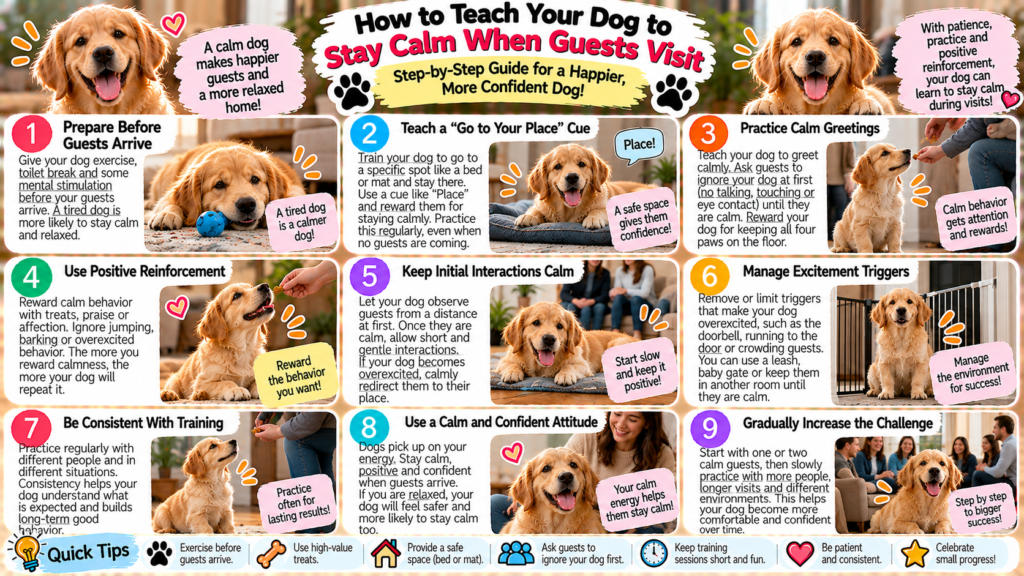
Teaching your dog to stay calm when guests visit is possible with a consistent and thoughtful training approach. Begin by understanding your dog’s behavior, create a comfortable safe space, and practice basic commands before introducing visitors.
Use positive reinforcement to reward calm behavior, manage the entrance to prevent rushing, and introduce guests gradually. Make sure visitors understand your dog’s needs and respect its boundaries.
Most importantly, avoid forcing interactions or punishing fear. A dog that feels safe has a better opportunity to learn appropriate greeting habits.
With patience, suitable management, and regular practice, you can help your dog become more comfortable when people visit and create a safer, more welcoming home for everyone.